Introduction to Alpine Skiing Disciplines
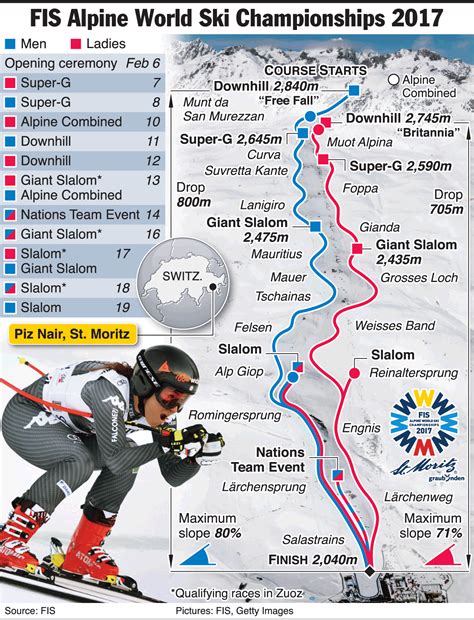
Alpine skiing encompasses six distinct disciplines: downhill, super-G, giant slalom, slalom, parallel slalom, and combined. Each discipline features a course marked by red and blue gates, consisting of pairs of poles joined by a fabric rectangle. The nature of these courses varies significantly between disciplines, differing in track length, elevation drop, number of gates, and spacing between them.
The "Speed" Disciplines
Downhill Skiing (Discesa Libera)
Often hailed as the queen of alpine skiing disciplines, downhill skiing is undoubtedly the most thrilling due to the extreme speeds achieved on the course. Compared to other speed events, the downhill track includes more turns and a greater number of gates to navigate.
The elevation drop for downhill courses ranges from 250 to 400 meters for women's competitions and from 250 to 450 meters for men's. Each race features between 30 and 65 gates.
The competition is held over two runs, on different courses, on the same day. For the second run, the starting order for the top 30 competitors from the first run is reversed. The final standings are determined by summing the times from both runs.
Super-G (Super Giant Slalom)
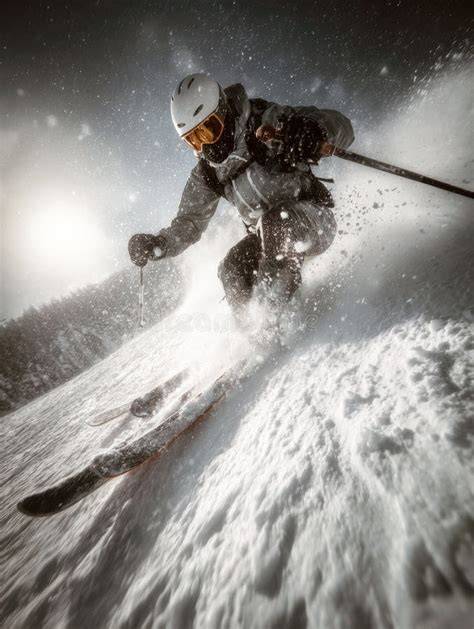
Super-G is the second fastest discipline in alpine skiing and one of the more recent additions, introduced by the International Ski Federation in 1982. It can be described as a slalom with wide turns. The course is marked by pairs of gates and indicated by blue transverse and longitudinal lines. Skiers are disqualified if they miss even a single gate during their descent.
The "Technical" Disciplines
Slalom (Slalom Speciale)
Slalom is considered the most technical discipline in alpine skiing. The gates are positioned closer together than in giant slalom, demanding very fast turns and rapid changes in direction. Skiers approach the gates head-on, making this discipline particularly exciting. The speed rarely exceeds thirty kilometers per hour. Typically, slalom competitions consist of two runs, with the winner being the skier with the lowest combined time, provided they navigate all gates correctly.
The elevation drop for slalom courses ranges from 140 to 220 meters for women and from 180 to 220 meters for men. Each course has between 40 and 75 gates.
The competition involves two runs on the same day, using two different courses. In the second run, the top 30 skiers from the first run start in reverse order of their provisional ranking. The times from both runs are added together to determine the final classification.
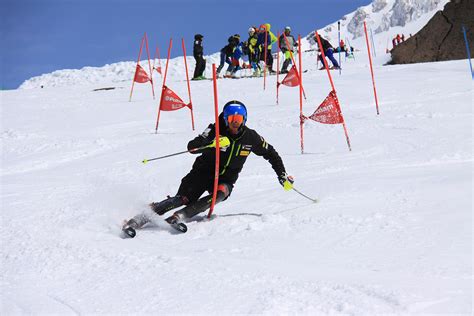
In slalom, skiers must navigate a course by weaving through a series of articulated poles placed in quick succession to the finish line. Skiers often touch the poles during their passes, necessitating the use of protective gear for hands, legs, and face.
Slalom gates are marked by two single poles, alternating red and blue, without flags (historically, they were equipped with triangular flags of the same color as the pole). Since the 2015/2016 season, the pole that was not typically hit by the athlete (i.e., the one furthest from the ideal trajectory) is no longer placed; the two poles remain to define the slalom gate in terms of vertical figures (double, triple, quadruple). Articulated poles are used, which are knocked down by poles and legs.
The maximum speed reached is around 60 km/h. The current men's World Cup slalom leader is Henrik Kristoffersen, and the women's leader is Zrinka Ljutić. The reigning World Champion is Loïc Meillard for men and Camille Rast for women.
The slalom special, commonly referred to simply as slalom, is one of the technical disciplines of alpine skiing. It involves skiers passing through a series of gates made of thin poles planted vertically in the snow. Historically, the poles were rigid and had triangular flags; if a skier touched a pole, it would move and had to be straightened by course attendants. In recent years, the poles have become articulated at the base to return to a vertical position if touched, and the flags have been removed.
Slalom and downhill skiing are the oldest disciplines of modern alpine skiing. Races in both disciplines have been held since the first Alpine Skiing World Championships in 1931 and have been part of the Olympic program since the Winter Olympics of 1948. The adjective "special" (used only in Italian) was added starting in the 1950s when the new discipline of giant slalom was introduced.
In slalom, the turns have a much tighter radius compared to giant slalom. The gates are marked by two single poles, alternating red and blue, without flags.
Giant Slalom (Slalom Gigante)
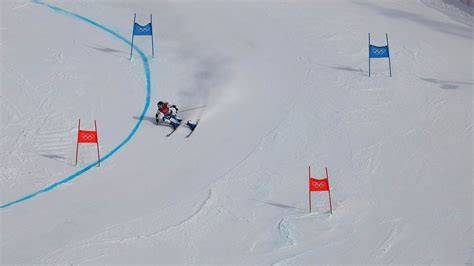
Introduced into the Olympic program at Oslo in 1952, giant slalom combines speed and technique. The course features alternating right and left turns. The turns on the giant slalom course are wider than those in slalom, and the gates are marked by gates rather than poles. It does not require specialized protective gear beyond standard equipment, as the gates are touched less frequently.
The event, considered the fastest technical discipline, involves two runs held on the same day. The course is marked by pairs of gates and is indicated by blue transverse and longitudinal lines. Skiers are disqualified if they miss any gate.
Combined Disciplines
Combined (Combinata Alpina)
The combined event consists of a downhill or super-G race followed by a slalom race. The times from both runs are summed to determine the final classification. However, fewer combined races are held during the ski season. As skiers tend to specialize in either speed or technique, this discipline, which relies on versatility, is becoming less common.
The combined event rewards the most complete athlete. The format typically includes a speed event (downhill or super-G) followed by a slalom run. There is also a super-combined variant, introduced in 2005, which consists of a short downhill and a single run of one of the two slalom disciplines.
Team Combined
The team combined is a mixed event where each country fields two athletes of the same gender, one competing in the speed event (downhill or super-G) and the other in the slalom portion of the combined. The final ranking is determined by the sum of the two times. In the combined event, the slalom leg is run as the second part of the competition, following the speed event.
Parallel Disciplines
Parallel Slalom (Slalom Parallelo)
Parallel slalom is a newer, spectacular discipline. Skiers compete head-to-head on two identical parallel courses. The courses have an elevation drop of 80-100 meters and feature 20 to 30 gates each. Up to 32 competitors participate in the final phase of the competition. Skiers race in two runs, with the fastest in each heat advancing to the next round, similar to a tournament format. The rules for this discipline are subject to constant change to accommodate the needs of the athletes.
This is a race where two skiers of the same gender from the same National Olympic Committee (NOC) compete against each other on short parallel slalom courses. It is considered a minor discipline and is much shorter than the others.
Key Races and Historical Context
World Cup and Olympics
At the highest level, alpine skiing takes place in a World Cup circuit that rewards the best skiers over an entire season. Alpine skiing has been an Olympic sport since 1936. At the Milano-Cortina 2026 Olympics, alpine skiing will feature various disciplines with different courses, speeds, and rules.
Slalom and giant slalom involve closely spaced gates and numerous turns. Slalom, in particular, is a highly technical discipline with the most "dense" course requiring continuous changes in direction. Winning requires not only speed but also extreme precision without missing the correct passage between gates. The final time is the sum of the first and second run times, with the lowest total winning. The main rule is to pass through all gates correctly; each gate is a mandatory passage between two poles. Missing a gate, passing it on the wrong side, or not respecting the required passage results in disqualification. Falling and not finishing a run means no valid time is recorded, leading to elimination from the race.
The second run has a specific starting order: the top 30 skiers from the first run start in reverse order, with the 30th-placed skier starting first and the 1st-placed skier starting last.
Historical Significance
Slalom special and downhill skiing are the oldest disciplines of modern alpine skiing. Races in both disciplines have been held since the first Alpine Skiing World Championships in 1931 and have been part of the Olympic program since the Winter Olympics of 1948. The adjective "special" was added in the 1950s with the introduction of giant slalom.
Records and Notable Athletes
Olympic and World Records
It is challenging to speak of absolute "records" in alpine skiing due to the constantly changing courses at each Olympics. At Beijing 2022, the men's slalom was won in 1:44.09 and the women's slalom in 1:44.98. In 2022, Clément Noël won the men's slalom, and Petra Vlhová won the women's slalom.
In Italian Olympic history, slalom has two notable gold medals: Giuliano Razzoli in 2010 at Vancouver for the men and Paola Magoni in 1984 at Sarajevo for the women.
Italian Athletes
For the Milano Cortina 2026 Olympics, the men's slalom is scheduled for Monday, February 16th, with the first run from 10:00 to 12:30 and the second from 13:30 to 15:10 at the Stelvio Ski Centre. The Italian men's alpine skiing team includes Dominik Paris, Giovanni Franzoni, and Florian Schieder, with a fourth spot potentially filled by Christof Innerhofer or Mattia Casse based on final race selections.
The women's slalom will take place on Wednesday, February 18th, with similar timings at the Tofane Alpine Skiing Centre. The Italian women competing in this discipline are Lara Della Mea, Martina Peterlini, Anna Trocker, and Giada D'Antonio.
The men's team combined event is scheduled for Monday, February 9th, at the Stelvio Ski Centre, starting with the speed event (Team Combined Downhill) from 10:30 to 13:00, followed by the slalom (Team Combined Slalom) from 14:00 to 15:25.
Safety and Preparation
Alpine skiing is an exciting sport but involves inherent physical risks associated with speed, slope steepness, and significant joint stress. The medial collateral ligament is particularly vulnerable, especially for beginners who excessively stress the inside of the knee. Prevention plays a crucial role: targeted athletic preparation in the preceding months allows muscles to better support the joints under strain, reducing fatigue, which is a primary cause of technical errors. Furthermore, equipment maintenance and correct binding calibration, entrusted to professionals, are essential steps for ensuring safety.
Evolution of Skiing and Equipment
Alpine skiing, the national sport in Austria and Switzerland, ranks these countries first and second in the all-time Olympic medal count. Italy is fifth, having produced several champions, most notably Alberto Tomba, the most decorated Italian athlete with three Olympic golds and two silvers, two World Championship golds and two bronzes, and 50 World Cup victories. On the women's side, Deborah Compagnoni is a star, the only alpine skier, male or female, to win three golds in three different Olympic editions. Italy's first Olympic title was won by Zeno Colò in the Oslo 1952 downhill, and the latest by Sofia Goggia at Pyeongchang 2018.
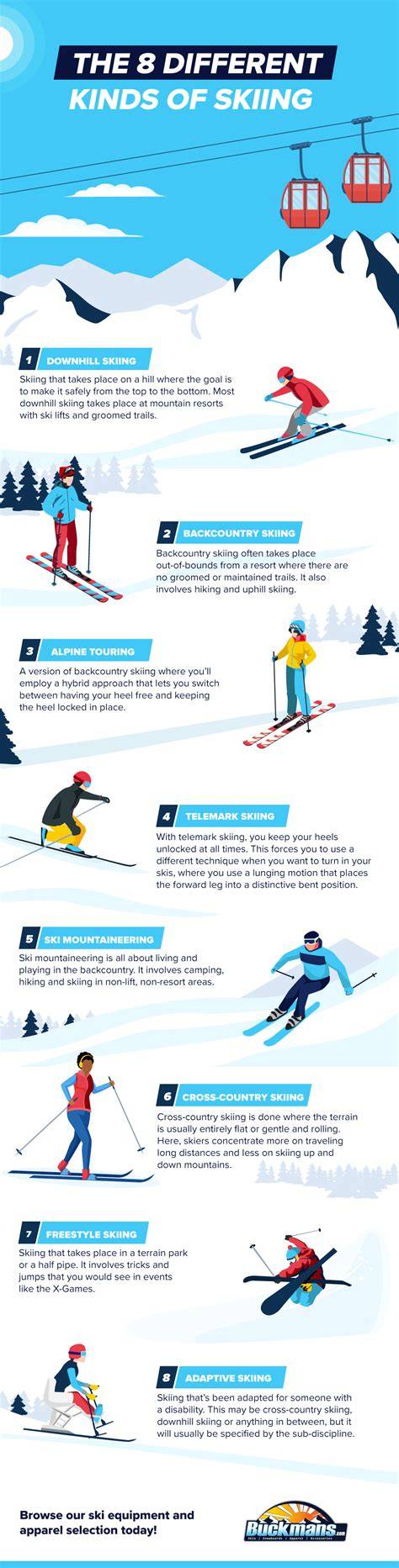
Unlike cross-country skis, the heel is fixed for stability. Alpine skis are wider and feature an edge on both sides for turning. The fundamental rule of alpine skiing is to descend snowy slopes in the shortest time possible. In the "speed" disciplines (downhill and super-G), athletes compete in a single run, with the fastest time winning. In the "technical" disciplines (slalom and giant slalom), there are two runs, and the sum of the times determines the winner.
Alpine skiing debuted at the Winter Olympics in 1936 in Garmisch, Germany, and has been a consistent part of the Olympic program ever since.
Understanding the Differences
While some winter sports may appear similar, a closer look reveals significant differences between them. Speed events include downhill and super-G; technical events are giant slalom and slalom, while the combined is a mix of speed and technique, featuring one speed run and one slalom run.
Downhill (Discesa Libera)
This is undoubtedly the iconic event of alpine skiing. The format is straightforward: point the skis downhill, launch from the starting gate, and descend at full speed. Speeds of around 130 km/h are common, but can be higher depending on the course. Jumps spanning tens of meters are also a typical characteristic of downhill. Downhill skiers are generally taller and heavier than slalom and giant slalom skiers and possess powerful leg strength. Downhill races are held on longer courses at higher speeds, often leaving athletes exhausted at the finish line due to lactic acid buildup.
Super-G
There is less elevation drop compared to downhill, and the gates are closer together. Athletes are not allowed timed practice runs, which are typical for downhill. Competitors study the course only during a single reconnaissance run before the race.
Giant Slalom (Slalom Gigante)
The fastest technical event, giant slalom, involves two runs held on the same day. The course features wider turns than slalom and is not marked by poles but by gates. It does not require special protection beyond standard gear, as gates are touched less frequently.
Slalom
Slalom is the most technical event in alpine skiing, with closely spaced gates that present numerous challenges and traps in the course design. The event is again held in two runs on the same day, on two different courses. The top 30 skiers from the first run start in reverse order of their ranking for the second run. The times from both runs are summed to determine the final classification.
🥇🥈 for USA in Freestyle Skiing Beijing 2022 | Men's Slopestyle final highlights
This event will feature two athletes of the same gender from the same National Olympic Committee (NOC) competing together. The race format includes a downhill run and a slalom run.